For our teaser trailer we had to create our own original non-diegetic music to make the action on screen more effective, and more interesting to watch.
As our trailer is a Psychological Thriller, we watched many other real media from this same genre, in order to gain inspiration.
One of our most predominant influences, for not only narrative, but music too, was Requiem for a Dream. This trailer uses fast paced, club-like music, which mirror the party shots. This music highlights the way in which the drugs are initially used - in order to have fun. The music connotes this enjoyment through its upbeat rhythm.
However, on several occasions, the on screen action does not fit this upbeat music, as it displays mental breakdowns, and entrapment, such as the character screaming for help while in prison, and the protagonists falling into lives of addiction, pain and prostitution. Therefore, it can be suggested that, although on the surface it appears to be a positive depiction of partying, drugs, sex, and fun, as suggested by the music - this music is actually perhaps contrapuntal as a darker message of helplessness and pain is presented. This could be suggestive of the negative effects of drugs and addiction.
This clip presents the upbeat music used in the trailer:
In our trailer, we utilised the music in a similar way; we created a soundtrack from a remixed club version, of a pop, upbeat song. This mirrored the club-scene effect we were striving for, it suggested that the protagonist has started to experiment with drugs primarily due to the surroundings she now, as a young adult year old, finds herself in, such as parties, clubs, experimentation with drugs, sex, and alcohol. The music mirrors that of the music she would listen to, while in these situations.
Similarly to Requiem for a Dream, although the music mirrors the enjoyment she may initially experience while at these parties (as presented through the dancing shots), it also contrast the shots nearer to the end of the trailer, as she begins to lose control, and lacks mental stability. Shots such as her spitting out blood, and starting to experiment with hard, dangerous drugs, by injecting them, contrast the non-diegetic music, as they are portrayed negatively and suggest danger and unhappiness.
We aimed to portray helplessness, and the negative effects of addiction throughout the trailer. This is similar seen in Requiem for a Dream.
This clip presents the club-like music used in our trailer:
Another aspect of the sound that we looked at, and researched, was the way in which the Psychological Thriller teaser trailers often ended. It appeared to be a common convention that there would be a increase in tension throughout the trailers, which was followed by a moment of quiet and immediately contrasted by a climatic loud moment, mirroring the on screen shot. This is done to lure the audience into a false sense of security, by allowing them to believe the tension, and most dramatic shots was over, and had already been conveyed, then the climax is shocking, and induces surprise and perhaps fear. This is done to hook the audience, and having the climax at the end, with no restoration of equilibrium, it leaves a sense of complete ambiguity, resolving nothing, and leaving the audience with a mystery.
This technique is found in Requiem for a Dream, as the trailer goes in a full circle, starting with dialogue and no non-diegetic, ending with the same dialogue and no music, then this is immediately followed by the character screaming underwater - which creates this sense of fear and mystery.
This clip conveys the ending music used in Requiem for a Dream:
For our trailer, we followed this convention, by having a short moment of silence immediately followed by a shocking climatic moment. We did this to hook the audience, by leaving the trailer as ambiguous and mysterious, and to create the element of shock.
This clip depicts the ending music used in our trailer:
Showing posts with label Jayda. Show all posts
Showing posts with label Jayda. Show all posts
Thursday, 7 April 2016

Tuesday, 5 April 2016
contrasting shots
graphic match shots at start contrast with running shot at end
still vs hand held
both from behind
walking vs running
change in her mental state
still vs hand held
both from behind
walking vs running
change in her mental state
Thursday, 10 March 2016
Whiplash Poster Deconstruction
 Whiplash is a 2014 Drama directed by Damien Chazelle which follows the story of an aspiring young jazz drummer. Interestingly, unlike most film posters, the majority of the page is taken up by large bold reviews. The typography is very clear to read and is a large font. The text at the top and the bottom is a vivid red, and the middle is a very pale blue, these colours both contrast against the black background, causing them to really stand out on the page, drawing the eye straight to them. The colour red could be used in order to draw immediate attention to this information, which tells the reader which awards the film has one, the title of the film and the main actors playing in it. This follow the conventions of a film poster, by attempting to persuade the reader, the awards suggest that the film is unmissable, the named actors draw in fans of these celebrities, and the title is bold and red so it is more memorable.
The pale blue tint of the rest of the typography is also seen on the small image of Miles Teller, it can be suggested that, because of the negative connotations of the colour blue, this represents the protagonist's disappointment and disheartened nature throughout the film. It can be depicted that the contrast between the red and blue typography mirrors the narrative, as the red connotes the protagonist's passion for drumming, this is the brightest and most vivid aspect of both the page and his life. Whereas the blue connotes the constant disappointment he feels and the negativity he receives from his drum teacher (J.K. Simmons). This is the most prominent aspect of the page, covering the majority of it, mirroring how he allows his teacher's discouragement to over take his whole life, including his passion.
Additionally, the contrast between the small scale of the image of Miles Teller and large bold reviews demonstrates how the protagonist values praise over his own self. Within the plot of the film the protagonist injures himself and makes himself unwell in order to please his drum teacher, therefore the overwhelming size of the reviews suggest that this are more important to him that his own life and health.
Furthermore, throughout the film the protagonist strives for praise and encouragement, yet receives near to none, therefore this poster displays what he has always desired and never achieved, as he is surrounded by positivity an praise.
The simplicity of this poster demonstrates his focus on drumming, and the spotlight both highlights his desire to perform and both literally and figuratively be in the spotlight, and it suggests the pressure he feels to be one of the greatest jazz drummers.
Thursday, 18 February 2016
What We Changed
After completing our first draft, we received detailed audience feedback from a focus group of 17-20 year olds on how to improve the piece.

 It was suggested that the beginning section of the trailer did not effectively convey the Psychological Thriller genre, due to the slow pace, continuity, and high-key lighting.
 The opening montage was seen as too similar to a film opening, rather than a teaser trailer, and conveyed aspects of Social Realism, as opposed to Psychological Thriller. Because of this we decided to remove the opening montage, in order to focus more on her drug addiction, and added in drug shots, such as an extreme close up of a syringe, the protagonist drinking alcohol, and pills spilling onto a counter.
 After listening to the feedback we decided to make the trailer more effective we needed to further display the protagonist's descent into addiction and insanity. In order to depict her powerlessness and breakdown, we needed to add more drug fuelled shots, and more shots of her breaking down into madness, such as multiple drug shots.
For the drug taking scene it was brought to our attention that there was not enough variation in shots, there were too many repeated shots with red lighting. Therefore, we subsequently removed several of the shots that we had repeated of her dancing, and added in more shots of her breakdown, such as the protagonist breaking the fourth wall and laughing into the camera.


Additionally, in our draft it appeared that the protagonist's mental instability occurred over the process of one night after the party, however we had intended to portray a breakdown over a longer period of time. In order to change this we added more locations, such as the living room, and also styled her with a multitude of costumes. This also more closely followed the conventions of a teaser trailer, which display events that take place over a longer period of time.
 One of the main issues that came to our attention was the main drug used during the initial drug taking scene. Feedback from the focus group told us that the drug appeared too unrealistic and unintimidating, therefore to really emphasise the dangers of the drug use we changed this to multiple drugs all falling onto the camera, we did this to highlight how the increase in drug use, within society, as visually they are everywhere, covering the screen completely.
 We were told that a way we could improve our trailer would be to add more creative editing, and camera angles. We achieved this by creating unique shots with the GoPro, this included
experimenting with taping the camera to the bottom of a glass bottle, we edited this into a
 match on action shot of our protagonist drinking alcohol. Additionally, we put the GoPro at the bottom of a full bath and created an ambiguous shot of the protagonist screaming underwater. This follows the conventions of a Psychological Thriller as it adds a sense of mystery. We also expressed creativity through the trailer with graphic matching at the start, before she attends the party. In these shots she is facing away from the camera, getting ready and walking, the repetitiveness of the shots mirror the normality of her life before it is disrupted by drugs.
To make the pace of the trailer more effective we most shots, making them shorter, and added a variety of very fast paced new shots. We edited this in a way so it was in time with the non-diegetic music, so at each new beat there was a new shot. This new faster pace was not only parallel to the music, but also the narrative as it created tension and created a sense of lack of control, as it goes so fast the audience is almost unable to focus on the whole thing - similar to how the drug addiction is affecting the protagonist.
Sunday, 14 February 2016
Survey Monkey - Initial Ideas
Initial Audience Feedback
After developing a few initial ideas for the trailer we created a survey that was answered by 16-18 year olds, and was about what they as an audience believed would be more effective for our trailer. We did this to see what this audience would expect from a Psychological Trailer, and what they would want to see in one. Therefore, after collecting their answers we could respond accordingly within our media piece.

 For question one,we got a brief idea of what our audience expected from a Psychological Thriller, and from this we could see that the majority of responses expected to see drugs, dark lighting and red lighting. We thought it was very interesting too see how our audience saw the significance of lighting for Psychological Thrillers, this could be because of the conventions of most well known Psychological Thrillers, such as Requiem for a Dream, as they often portray the colours red and black, and deal with psychological issues such as drugs. Additionally, this could be because the audience picks up on the dark connotations of darkness and red imagery - therefore as from this survey we became immediately aware of the audience's belief of the importance of lighting - this was a very signifiant and prominent aspect of our trailer.
 Therefore, in order to comply with these, we used low key lighting throughout the more drug-fuelled shots, and used a prominent red colouring for the drug taking scene. This colour use fulfilled the audience's expectations of what a Psychological Thriller should appear like. We had the theme of drugs throughout, with repeated extreme close up shots of various drugs, and a suspenseful drug taking scene.
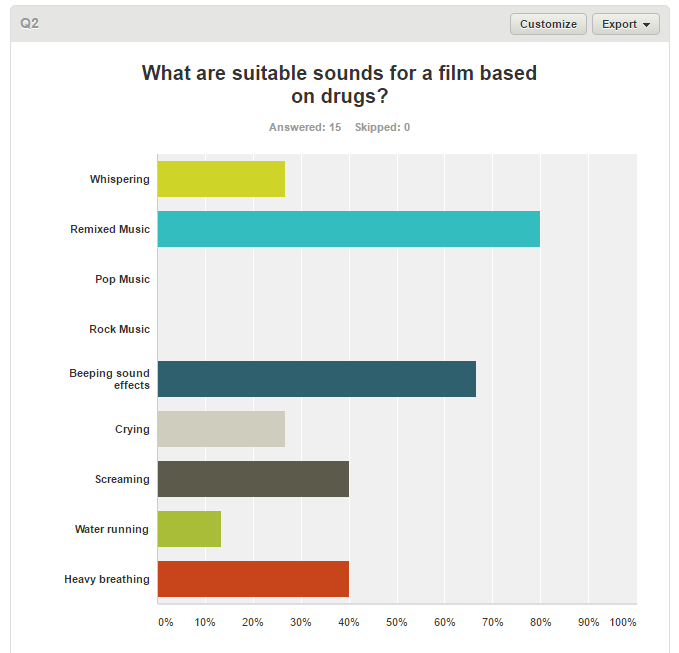

For this question we wanted to see what sounds the audience thought was most relevant for a Psychological Thriller, the most popular answers were 'remixed music' and 'beeping sound effects'. We found this response interesting, and thought the popularity of the answer could be because we were asking a younger audience, and as this genre of music is more lively and youthful it is more relatable to a younger audience as it is what they are used to being exposed to. It can be suggested that Psychological Thrillers typically have an older, more adult-based audience, so by using a very current remixed songs, we appealed more to our target demographic. We can also suggest that with modern drug-fuelled media, such as Pulp Fiction, Skins, Breaking Bad, and Trainspotting, the drugs are depicted in a positive way, which is mirrored by the party/club scenes and the upbeat, positive/lively music used - therefore this is what our target audience is accustomed to and associated drug scenes with.
This response could also be because the remix of music can add to the fast pace of the trailer, and can also create a sense of distortion that the drugs create.
The monotony of the beeping sound is effective as it can contrast the fast paced variety of shots. We decided to start the trailer with the sound effect of an alarm clock, in order to convey they initial normality of the protagonist's life. This then increased in speed, and began to resemble a heart monitor, this symbolised the change in her life as she began experimentation with drugs. The switch from normality resembles the disruption in her life.
This response could also be because the remix of music can add to the fast pace of the trailer, and can also create a sense of distortion that the drugs create.
The monotony of the beeping sound is effective as it can contrast the fast paced variety of shots. We decided to start the trailer with the sound effect of an alarm clock, in order to convey they initial normality of the protagonist's life. This then increased in speed, and began to resemble a heart monitor, this symbolised the change in her life as she began experimentation with drugs. The switch from normality resembles the disruption in her life.
For the drug fuelled shots we created a remix of several popular songs, these mirrored the on screen action, as we edited the shots so they were synchronous with the music. Additionally, the mash up of songs added to the distortion that was created through post-production editing, such as layering.


 This question was asked in order for us to be able to narrow down which colours we focused on within our trailer. The audience's belief of the significance of lighting, and the prominent connotations of red and back is again very evident in this question. This could be because of the common use of this low-key lighting and red and black colour imagery, in modern Psychological Thrillers that our primary audience will be used to watching, such as Se7en, The Machinist and The Silence of the Lambs
Both black and red follow the conventions of a Psychological Thriller, and they obtain negative connotations, such as evil and blood, which are what we were aiming to convey. This is likely to be why the majority of the audience chose these answers.
We made red our most prominent colour used in order to depict the real shift in the protagonist's life. The red symbolised danger, fear, corruption and blood - which are all themes conveyed within our trailer. We use the red lighting very explicitly in the drug taking scene, and then it is most subtly displayed throughout the rest of the trailer (eg blood).


For this we wanted to see what the audience expected to see regarding a drug addiction, and whether they would expect to see it in a more negative or positive light. The majority of responses were what we had anticipated they audience would want to see, which was they would expect to see the themes of addiction, vulnerability and insanity. We can suggest that the audience expects to see this due to the effects of drugs, and how they are often portrayed to take a negative toll on the user's life. Additionally, we can consider how drugs are such a dominant aspect modern society, especially within youth culture - therefore these negative themes, such as vulnerability, depression and addiction, are the most common answers as this is what our audience is used to being surrounded by.
We used the mise en scene, lighting, editing and camera work in order to depict these themes.
progressive addiction.
 We illustrate the theme of vulnerability through her inability to stop her addiction, she has lost control to it. This is depicted through shots of the physical effects that the drugs have on her, such as nose bleeds, and her spitting out blood. We also convey her lack of control through shots of her screaming and running, to highlight her unhappiness and vulnerability.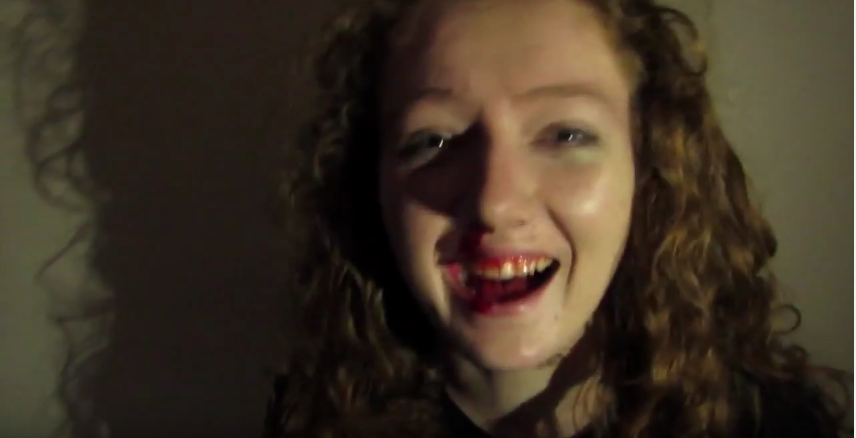
We depicted insanity by breaking the fourth wall and having our protagonist laughing into the camera in spite of the pain and suffering she is experiencing. This presents her psychological disturbance, and follows the conventions of a Psychological Thriller.


This question gave us more of an idea of the specific ways in which an audience expects to see a drug addiction presented on screen. The most popular responses were for there to be multiple shots of drugs, and for there to be a fast pace. This was an interesting response as it gave us an insight into what our audience perceives to be important aspects of a drug addiction. Multiple drug shots indicates that an audience sees drug addictions as something extreme, where the user is completely submerged in a drug-fuelled experience and life. This suggests that the audience views drug addiction in a negative light, as it puts forward the idea that they see it as dangerous.
Additionally, the popularity of the answer 'fast pace' illustrates that they see the overwhelming effect of the drugs, which causes distortion and disruption within a normal life. These opinions could again be because drugs have become so common within modern society, to the extent where our audience is very aware of the danger and disruption of this.

We used various extreme close up shots of numerous different drugs to display her addiction. We used an overwhelming amount of tablets, and covered the entirety of the camera lens, this suggests how inescapable the drugs are to the character, and how they have become the most pivotal aspect of her life.
 Additionally, we scattered a variety of pills over a counter top, this demonstrated the sheer amount of them, and by being thrown carelessly around it mirrors the protagonist's lack of control.
Throughout the trailer we utilise a very fast pace, keeping the shots in time with the non-diegetic music, this represents the chaos in her life, and suggests that everything is all happening so quickly she has no time to process it all, or do anything to change it.
We also used other, less popular, answers to this question to convey her addiction, such as breaking the fourth wall, screaming shots, fish eye effect and blood, as we felt these all conveyed a psychological breakdown, and depicted her descent into insanity and addiction. Also, some of these shots, such as the fish eye effect used during the party scene add to the sense of distortion which is caused by the effects of drugs. We also created this effect though post-production editing, such as layering
Throughout the trailer we utilise a very fast pace, keeping the shots in time with the non-diegetic music, this represents the chaos in her life, and suggests that everything is all happening so quickly she has no time to process it all, or do anything to change it.
We also used other, less popular, answers to this question to convey her addiction, such as breaking the fourth wall, screaming shots, fish eye effect and blood, as we felt these all conveyed a psychological breakdown, and depicted her descent into insanity and addiction. Also, some of these shots, such as the fish eye effect used during the party scene add to the sense of distortion which is caused by the effects of drugs. We also created this effect though post-production editing, such as layering
Saturday, 30 January 2016
Under the Skin Website Deconstruction

Under the Skin is a 2013 Science Fiction-Horror film directed by Jonathan Glazer. The darkness and psychological disruption of this film was a prominent inspiration for our teaser trailer.
Within the narrative of this film one of the most important aspects is the ambiguity and mystery behind the protagonist, mystery is a common convention within Psychological Thrillers, therefore it can be argued that Under the Skin has elements of a Psychological Thriller, along side Science Fiction-Thriller. We took inspiration from this ambiguity for our teaser trailer.
This website is very minimal, with only part of Scarlett Johansson's face showing, as you scroll down the website the typography moves and changes, but the picture remains still. The colour lit onto the protagonist's face slowly shifts through several bright colours, such as red, pink, and blue - these colours are very bright and are the most prominent feature of the website. The stars in the background are very slowly, almost unnoticeably moving. Due to the film's Science Fiction side it can be suggested that the protagonist's face is presented in the middle of the dark night's sky in order to suggest the vast expanse of the universe, which leads to the idea of extraterrestrial life.
However, although the dark sky indicates the infinite nature of the universe, the pivotal aspect of the website is the protagonist's face, due to its central framing and large scale, demonstrating that she is the most significant aspect of the film. However her face is partially shadowed, suggesting a duplicitous nature. Additionally, the vividity of the red lighting on Johannson's face contrasts the stark black sky behind her, this connotes danger, and causes her to stand out against the mundane nature of humanity.

When on the website, once the audience has scrolled down, there are very clear media links to purchase the product. This is explicit advertisement, and allows easy access for the audience.
There is a common typography seen throughout the website, this is a very clear and easy to read font. It can be suggested that this font contrasts the abstract nature of the film.
The pastel blue colour scheme of the typography contrasts the black background, making it stand out.

Once the audience scrolls down further, reviews are presented on-screen. Unlike the media links, these take up the majority of the page, becoming the central focus, additionally, use of contrasting colours of the green typography against the red light on the protagonist's face makes the reviews stand out further.
This follows the conventions of a website, as its aim is to entice and persuade the audience, so by displaying all of the positive reviews and feedback across the whole of the screen, this reiterates to the reader just how good the film is, persuading them to watch it themselves.
Friday, 15 January 2016
Requiem For a Dream Teaser Trailer Deconstruction (Camera Work)
 The very first shot in this teaser trailer is an off centre still shot of the television, from behind the sofa, the mise en scene in this shot initially appears to be depicting normality, as an average living room setting is displayed, with a comfortable sofa, a table lamp and tea cups, which all connote comfort. However, the low-key lighting of the room creates an eerie feel, which is harshly contrasted by the bright colours on the television screen. The vivid colouring of the TV causes this the become the central focus of the shot, even though it is not central on the screen. This depicts the significance of the media, and television throughout the narrative of the film. This significant is also presented throughout the trailer though various other shots:

One of the main factors to the plot of this film is the use of drugs, this is depicted all the way through the trailer. One effective way in which this is done is through the use of extreme close ups, such as:
 Extreme close-up shots of the characters' eyes, which convey the physical effects that drugs have on their bodies; as the shot displays their pupils dilating.
Various extreme close up shots of drugs, such as a syringe, a lighter, and pills. These illustrate to the audience that the characters are using a dangerous amount of different drugs; it depicts how their lives are arguably drug-orientated, due to the sheer amount of it all.


Love is an theme which is displayed throughout this teaser trailer, it is depicted through various different shots:

A sexual love is conveyed through this elevator shot of the two characters kissing. Simultaneously, there is a non-diegetic voice over of the female character whispering 'I love you', which adds to this theme of love.
This shot has a post-effect over it which causes it to appear as if it is footage from the elevator camera, this could suggest that the characters are willing to express their love no matter who is watching.

Similarly to the previously discussed shot this suggests that the characters do not care about hiding their love, but want to express it regardless of the audience.

Familial love is also portrayed through this trailer, as it explores the love between the mother and son. This is conveyed through this close up of the two characters embracing. This is an important aspect of the narrative as their relationship is weakened as they are both caught up in drugs and addiction. The contrast between the bond they have prior to the drug use and their isolation after the drugs have taken their toll really emphasise the negative effects of drugs.

These shots are contrasted against the shots that are displayed in the later part of the trailer, which depict the very negative effects of addiction

Deconstruction of Requiem For a Dream Teaser Trailer- Editing
Editing Techniques

Distortion is a common theme throughout this teaser trailer, various aspects manipulate the shots in order to convey this, and the content of the film is highlighted in several ways. One very effective and common way in which this is done is through the editing; many of the editing techniques effectively exaggerate aspects of the trailer, such as split screens. These split screens emphasise the effect of the drugs and suggest that this is how the mind is effected. Additionally, as the drugs are presented on screen simultaneously with the characters, it suggests that they are losing as sense of self and allowing the drugs to take over.

A fish-eye camera lens is used throughout the trailer to reinforce the impression of distortion, it is presented as a point of view shot, and indicates that this is a mirror of the character's mental state.

Pace is used for effect in this teaser tailer, aspects of it are cut and overlapped to result in multiple shots being displayed on screen within a very shot space if time. This could be mirroring the internal chaos that is occurring within the characters. This fast pace is made to appear even faster when is it immediately juxtaposed by a following longer, slower shot. This draws attentions to these slower shots. signifying their importance and creating intensity.

The post-productions editing, such as layering, again reiterates this theme of distortion, as it physically distorts the onscreen images, making it difficult for the viewer to distinguish between images and be sure of what is happening.

Post effects such as the one seen on the right, are used to exaggerate the character's emotions, the onscreen action clearly conveys their distress, and the effect on top of this further demonstrates it.
Subscribe to:
Comments (Atom)