The house we are filming at is purposefully modern but basic- we want to create the atmosphere of a completely normal teenage girl's life. This will completely contrast the shots later on in the trailer, in which she has become addicted to the drug and this will be reflected by her surroundings. The contrast between the pale walls and the black floor show the opposite ends of her character, before and after she becomes addicted to drugs.
Wednesday, 18 November 2015
Friday, 13 November 2015
Deconstruction of Requiem For A Dream Trailer
The trailer starts with an establishing shot of an empty living room with the television on. Low key lighting is used, conveying a sense of uneasiness to the audience. This is followed by a split screen shot of a woman sorting her pills. There is a close-up pan of the different coloured pills on the table, indicating that the pills are a central part to the plot of the film. This further shown through the repetition of the voiceover used at the end of the trailer by the woman sorting the pills, where she says" Purple in the morning, Blue in the afternoon, and orange is the evening." This suggests the woman may be addicted to these pills, again conveying addiction as one of the central themes of the film. 
There are a variety of different camera angles and movement throughout the trailer. A fish eye is used in one of the scenes shown. This may be used to create a sense of disorientation for the audience, as well as a sense of uneasiness felt by the characters. Close-up shots are used frequently throughout the trailer, also creating the same effect.There is a close up of one of the characters in a nightclub, and another close-up of the lips of someone smoking, again conveying the theme of drugs to the audience. This is further shown through the close-up of an eye where the pupil grows bigger. This allows the audience to see the effect of a drug on the character. These types of shots allow the audience to see what is happening in a very creative way. This can also be seen in the shot of the orange, where it disappears in the next shot to show passing of time. Another shot showing this, is when one of the characters is walking down the street, whilst other people pass her in fast motion. This adds a sense of confusion for audience, linking to the conventions of a psychological thriller.
Fast paced editing is used in the trailer to show the variety of locations, as well as not giving too much away in what is happening in the trailer, as the genre of Requiem for a Dream is a psychological thriller, therefore not giving enough information to the audience in order for them to completely understand what is happening.
Audience and Certification
Our genre is Psychological Thriller, which typically is aimed at teenagers and adults. Some are rated 15 while others are 18, due to the conventions of this genre- drugs, alcohol, murder etc...
After researching on IMDB, 60% of the top Psychological Thrillers are certified 15 rather than 18. This broadens the audience more, allowing younger viewers to watch.
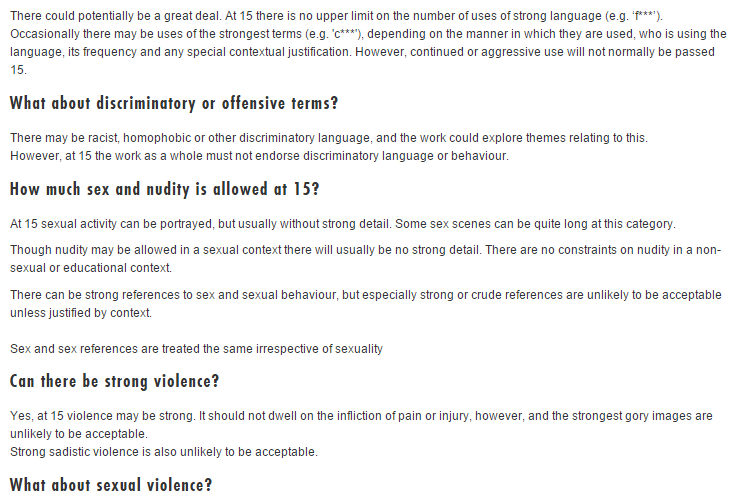
According to these rules from the British Board of Film Classification, our film would be rated a 15. It is likely that our film will contain strong language, and definitely drug taking. Our film would not 'endorse discriminatory language or behaviour'. As a psychological thriller that focuses on drugs, there would not be a strong focus on sex, but perhaps a few indications of it. Our film will not contain sexual violence and overall will display the negative effects of drugs rather than promoting them.
Thursday, 12 November 2015
Survey
From this question we can infer that our predominate demographic will be female. However, we aim to cater to a wider audience, consisting of all genders, as our trailer is not gender specific.
Due to our survey results for question 2, we have decided that the certification should be a 18, as the majority of our audience is around 18. Additionally, as our film tackles the negative implications and effects of drugs, this is a suitable topic for this age range, as it is not overly taboo, but very relevant to our audience.
As our results display that our demographic obtain a clear preference for the title 'Harmonious Delirium'. Therefore, this is the film title we have decided is best suited to our teaser trailer.
Due to the results of our survey, we have decided to subvert the convention of a psychological thriller by having a female protagonist.
After completely further research we have decided to use Studiocanal Production Company, as this is the production company for many of our main influences including Before I Go to Sleep.
Theories
Regarding the genre of psychological thrillers, one theory that is prevalent is Tzvetan Todorov's theory on Equilibrium.
He explains that most narratives start with a state of equilibrium, in which the protagonist leads a 'normal' and happy life.
Equilibrium, Disequilibrium, Attempted Repair, New Equilibrium.

Because of the fact that this is a Teaser Trailer, and is the first time the audience will get a glimpse of the film, it wouldn't make sense to end with Denouement- especially considering the genre is a Psychological Thriller. We plan to end our trailer on the climax, so that the audience will want to find out what the falling action and denouement consist of.
The Exposition introduces important background information.
The Rising Action shows a number of related incidents leading up to a consequence.
This consequence is the Climax, which changes the protagonist's fate. The situation changes from good to bad for the character.
The Falling Action stage contains conflict between the protagonist and others.
The Denouement should eventually create a sense of catharsis, ending the conflict.
Roland Barthes was a French Philosopher and Literary Theorist was said that texts are either open or closed, and are influenced by 5 codes:
Hermeneutic Code/ Enigma Code- this relates to clues and subtleties within a story. It leaves the audience wanting to know more which is exactly what a teaser trailer should do.
Proairetic Code- contains sequential elements of action in a story. These add suspense to the ambience, which adheres to the purpose of our genre: Psychological Thriller.
Semantic Code- these are aspects of the story that have more than one meaning. Since the trailer is so short and shouldn't give too much of the plot away, the audience will be able to interpret our trailer in a number of ways.
Symbolic Code- this refers to symbolism within a text, certain aspects of mise en scene can be used to show contrast, create greater meaning, create tension and add character development.
Referential Code- this code probably applies the least to us, and refers to cultural, historical and scientific knowledge.
He explains that most narratives start with a state of equilibrium, in which the protagonist leads a 'normal' and happy life.
Equilibrium, Disequilibrium, Attempted Repair, New Equilibrium.
Aristotle's Theory of Tragedy is also applicable to our trailer genre. He said that all narratives can be divided into 3 sections: the Protasis, Epitasis, and Catastrophe. The German novelist Gustav Freytag then split these up into 5 parts: Exposition, Rising Action, Climax, Falling Action and Denouement.

Because of the fact that this is a Teaser Trailer, and is the first time the audience will get a glimpse of the film, it wouldn't make sense to end with Denouement- especially considering the genre is a Psychological Thriller. We plan to end our trailer on the climax, so that the audience will want to find out what the falling action and denouement consist of.
The Rising Action shows a number of related incidents leading up to a consequence.
This consequence is the Climax, which changes the protagonist's fate. The situation changes from good to bad for the character.
The Falling Action stage contains conflict between the protagonist and others.
The Denouement should eventually create a sense of catharsis, ending the conflict.
Roland Barthes was a French Philosopher and Literary Theorist was said that texts are either open or closed, and are influenced by 5 codes:
Hermeneutic Code/ Enigma Code- this relates to clues and subtleties within a story. It leaves the audience wanting to know more which is exactly what a teaser trailer should do.
Proairetic Code- contains sequential elements of action in a story. These add suspense to the ambience, which adheres to the purpose of our genre: Psychological Thriller.
Semantic Code- these are aspects of the story that have more than one meaning. Since the trailer is so short and shouldn't give too much of the plot away, the audience will be able to interpret our trailer in a number of ways.
Symbolic Code- this refers to symbolism within a text, certain aspects of mise en scene can be used to show contrast, create greater meaning, create tension and add character development.
Referential Code- this code probably applies the least to us, and refers to cultural, historical and scientific knowledge.
Party Scene Filming 30/10/2015
These are some of the shots from our part scene footage: We used a fisheye for some shots and strobe lighting to create a distorted, but colourful effect that corresponds with what our protagonist may see after taking a drug.
This scene is entirely post-drug so we wanted it to be colourful and eccentric. The protagonist has lost some of her senses and is feeling lightheaded but ecstatic. Her vision is distorted and she is surrounded by people who are invading her personal space while doing more drugs.
Some people are wearing masks and this is something we would like to include as a theme within the party scene. Adding the bright colours only make the masks more creepy.
Dark shadows and silhouettes can be seen around the room and this adds to the thriller element of our teaser trailer. Seeing these ominous shapes moving around creates a sense of the unknown, and hints at the potential danger than our protagonist will encounter.
By not showing our protagonists face in the party, we create a sense of mystery surrounding her. All of the shots are from her own eyes, which allows the audience to experience everything as she is experiencing it- while on drugs.
Wednesday, 11 November 2015
Famous directors of Psychological Thrillers
One of the most famous directors of Thrillers is Sir Alfred Hitchcock, who has been named The Master of Suspense.
Hitchcock always said he's choose suspense over surprise and explained his choice with this aphorism: "There's two people having breakfast and there's a bomb under the table. If it explodes, that's a surprise. But if it doesn't...."
He also liked to make voyeurs of the audience with the use of point-of-view shots from obscure places.
Hitchcock popularised the 'MacGuffin which he often used in his thrillers, and since then, many other thrillers. This is when a protagonist in the film desires a particular thing (place, person, object...) for a reason unknown to the audience. An example is the plans for the airplane engine in The 39 Steps.
Another director famous for his Thrillers is Christopher Nolan.
A great article that explains 'Why Christopher Nolan films look like Christopher Nolan films' is in the link below, but the main points of it are:
One of the features that might make an audience infer it is a Nolan film, is the use of IMAX.
He also makes use of colour- his final project is always "epic and crisp" which is enhanced by the larger format of IMAX.
For almost all of his films, Nolan works with the cinematographer Wally Pfister, who contributes to the widescreen, aesthetically pleasing films we see Nolan directing.
http://www.theatlantic.com/entertainment/archive/2012/07/the-reason-christopher-nolan-films-look-like-christopher-nolan-films/260087/
A third director who is well known within this genre is Darren Aronofsky, the director of Requiem for a Dream and The Black Swan.
In his early films (Requiem for a Dream), he was renowned for his extremely short shots. While most films have 600-700 cuts, Requiem has over 2000.
Black Swan is one of his more recent films and one he filmed using a muted palette and grainy style to showcase the acting and narrative instead.
Similarly to Nolan, Aronofsky has worked with the same cinematographer for 6 films and this type of close relationship between a director and cinematographer enhances the quality of the film.

One last director who has had influence in the world of Psychological Thrillers, is David Fincher.
He has directed a number of films in this genre, and therefore has many distinctive features that label his films as his own:
Single Frame Inserts- when there's a flash on the screen in the middle of a scene.
Silhouettes
Low-key lighting with blue and green tints
Wide shots
Displays end credits as slideshows rather than the traditional method
Low angles
Flashbacks
Hitchcock always said he's choose suspense over surprise and explained his choice with this aphorism: "There's two people having breakfast and there's a bomb under the table. If it explodes, that's a surprise. But if it doesn't...."
He also liked to make voyeurs of the audience with the use of point-of-view shots from obscure places.
Hitchcock popularised the 'MacGuffin which he often used in his thrillers, and since then, many other thrillers. This is when a protagonist in the film desires a particular thing (place, person, object...) for a reason unknown to the audience. An example is the plans for the airplane engine in The 39 Steps.
Another director famous for his Thrillers is Christopher Nolan.
A great article that explains 'Why Christopher Nolan films look like Christopher Nolan films' is in the link below, but the main points of it are:
One of the features that might make an audience infer it is a Nolan film, is the use of IMAX.
He also makes use of colour- his final project is always "epic and crisp" which is enhanced by the larger format of IMAX.
For almost all of his films, Nolan works with the cinematographer Wally Pfister, who contributes to the widescreen, aesthetically pleasing films we see Nolan directing.
http://www.theatlantic.com/entertainment/archive/2012/07/the-reason-christopher-nolan-films-look-like-christopher-nolan-films/260087/
A third director who is well known within this genre is Darren Aronofsky, the director of Requiem for a Dream and The Black Swan.
In his early films (Requiem for a Dream), he was renowned for his extremely short shots. While most films have 600-700 cuts, Requiem has over 2000.Black Swan is one of his more recent films and one he filmed using a muted palette and grainy style to showcase the acting and narrative instead.
Similarly to Nolan, Aronofsky has worked with the same cinematographer for 6 films and this type of close relationship between a director and cinematographer enhances the quality of the film.

One last director who has had influence in the world of Psychological Thrillers, is David Fincher.He has directed a number of films in this genre, and therefore has many distinctive features that label his films as his own:
Single Frame Inserts- when there's a flash on the screen in the middle of a scene.Silhouettes
Low-key lighting with blue and green tints
Wide shotsDisplays end credits as slideshows rather than the traditional method
Low angles
Flashbacks
Subscribe to:
Posts (Atom)